
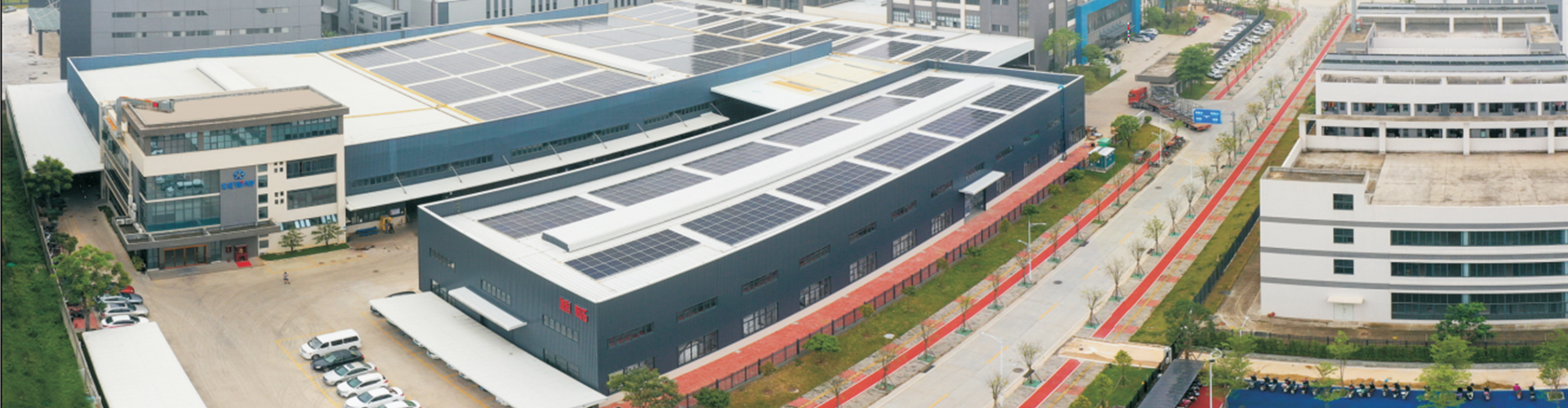
Among all glass deep-processing equipment, the glass edging machine is both the oldest and the most widely used. Its basic jobs: grinding flat glass edges and creating special shapes. When used correctly and maintained well, it ensures smooth production and extends machine life.
This report covers working principles, construction, major types, installation, maintenance, and safe operation – with special focus on five key machines: Glass Straight-line Edging Machine, Glass Miter Machine, Automated Glass Beveling Machine, Automatic Glass Double Edging Machine, and Glass Straight-line Pencil Edging Machine.
How It Works
The machine uses grinding head motors and wheels to grind and polish glass edges. Most single- or double-edge machines complete rough grinding, fine grinding, and polishing in one pass. Users can choose different wheels based on their needs.
A standard single-side glass edging machine consists of a main body (base, columns, front/rear beams, water tank, motors, electrical panel), infeed/outfeed guide rails, glass support racks, and a floor-mounted water tank. Material and motor quality affect precision and lifespan. For example, cast-iron bases and beams that are quenched can last 10–15 years.
Main Types and Their Functions
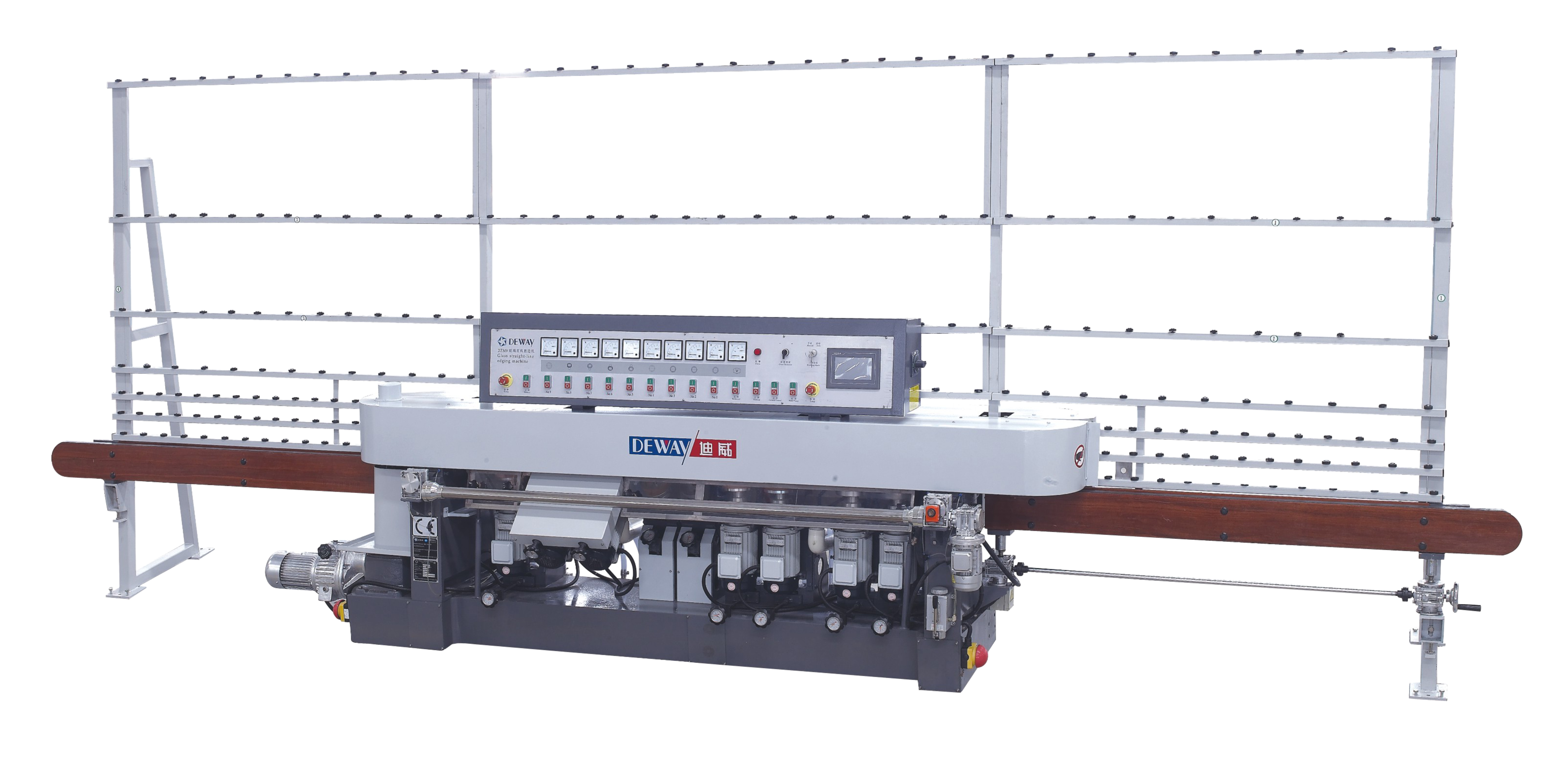
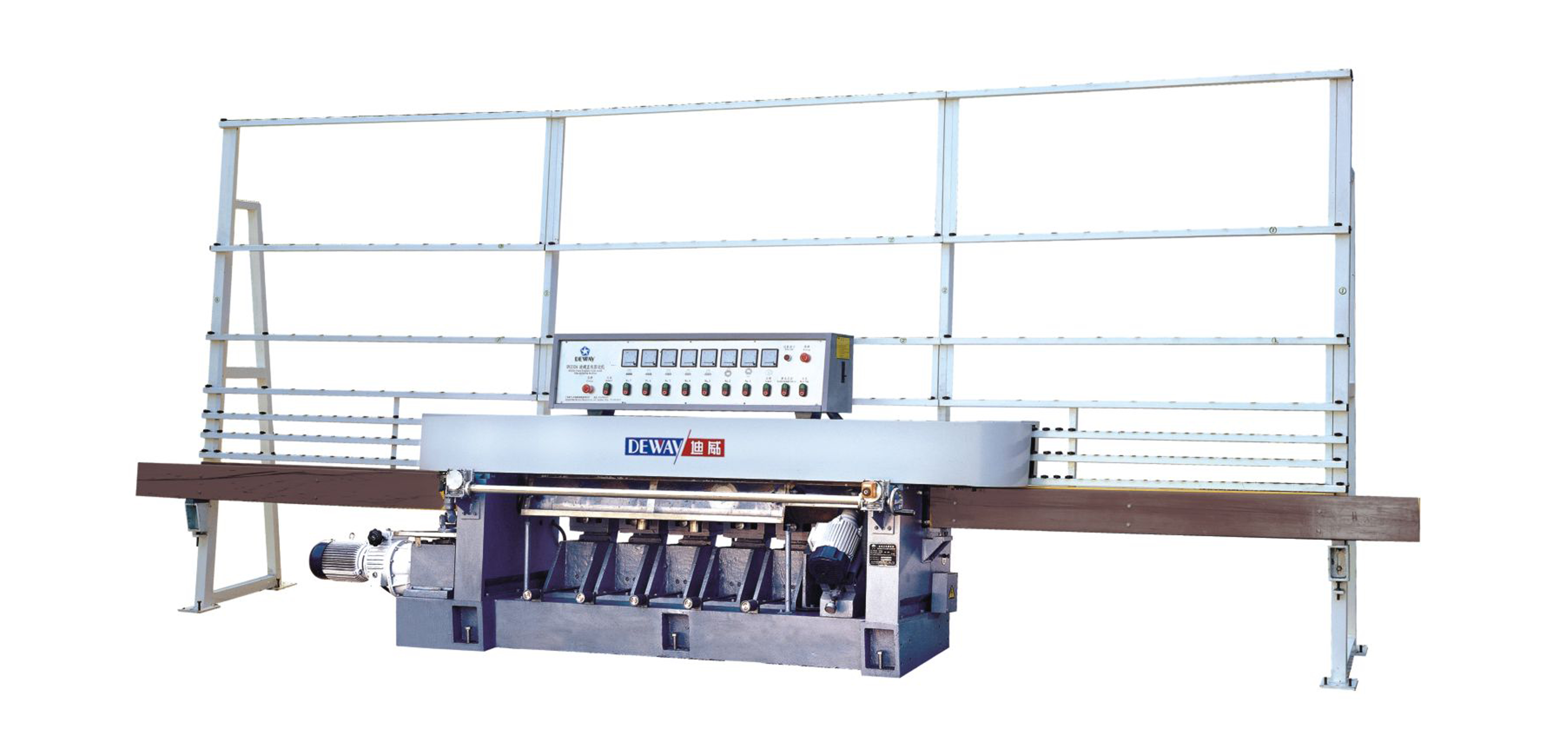
1. Glass Straight-line Edging Machine
This machine processes the bottom edge and chamfers of flat glass. It features a special telescopic pressing plate, with all grinding head carriages made of integral dovetail slides. Speed is adjustable. The design gives high rigidity, low vibration, and easy adjustment. Common models have 4, 8, 9, or 10 grinding heads.
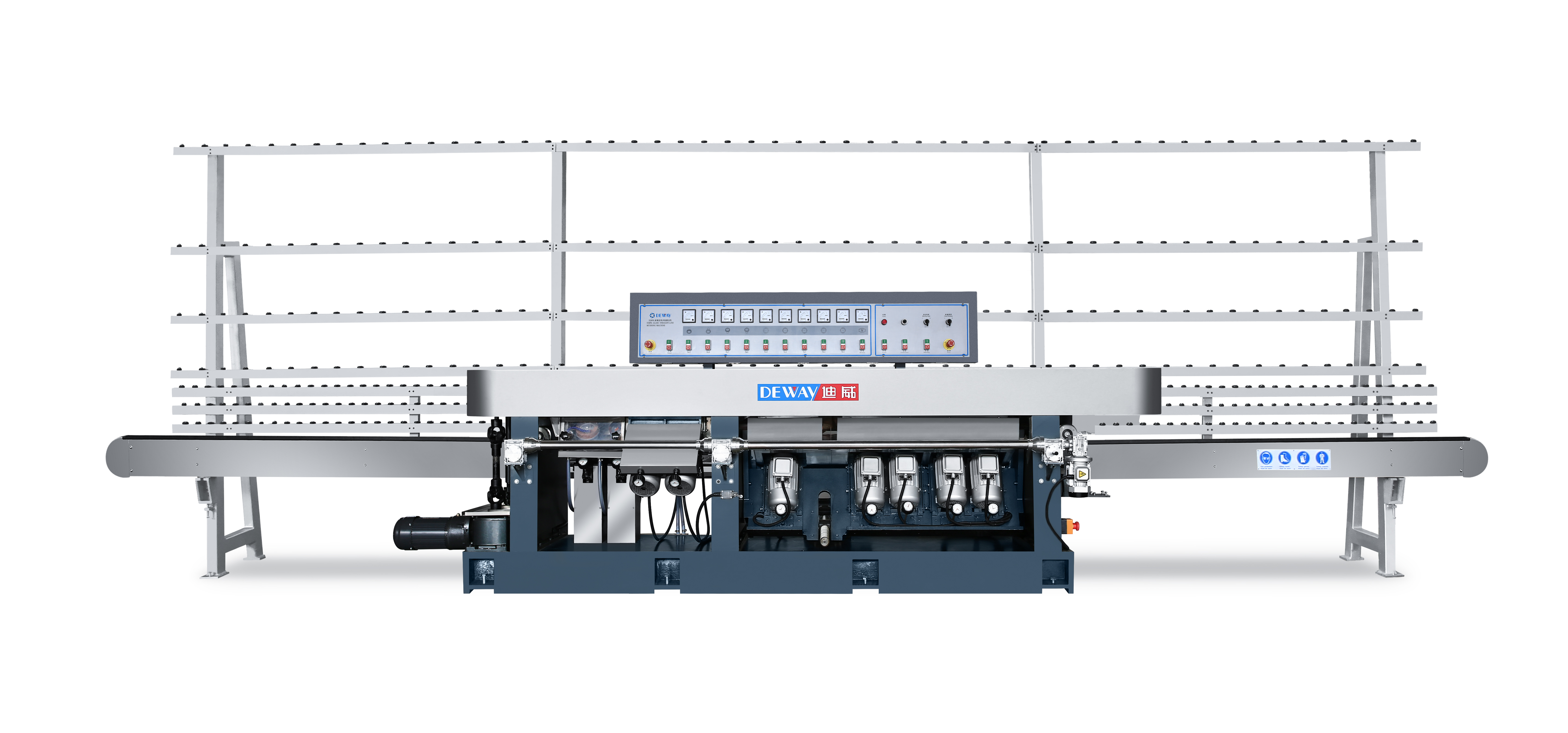
2. Glass Miter Machine
Also called a multi-level edging machine, it grinds straight edges and 45° miters on flat glass of different sizes and thicknesses. It integrates rough grinding, fine grinding, polishing, and chamfering in one process. The angle is adjustable from 0° to 45°. Feed speed and feed amount can be changed. A touchscreen shows angle and bevel width. Most units have 9 or 10 grinding heads.
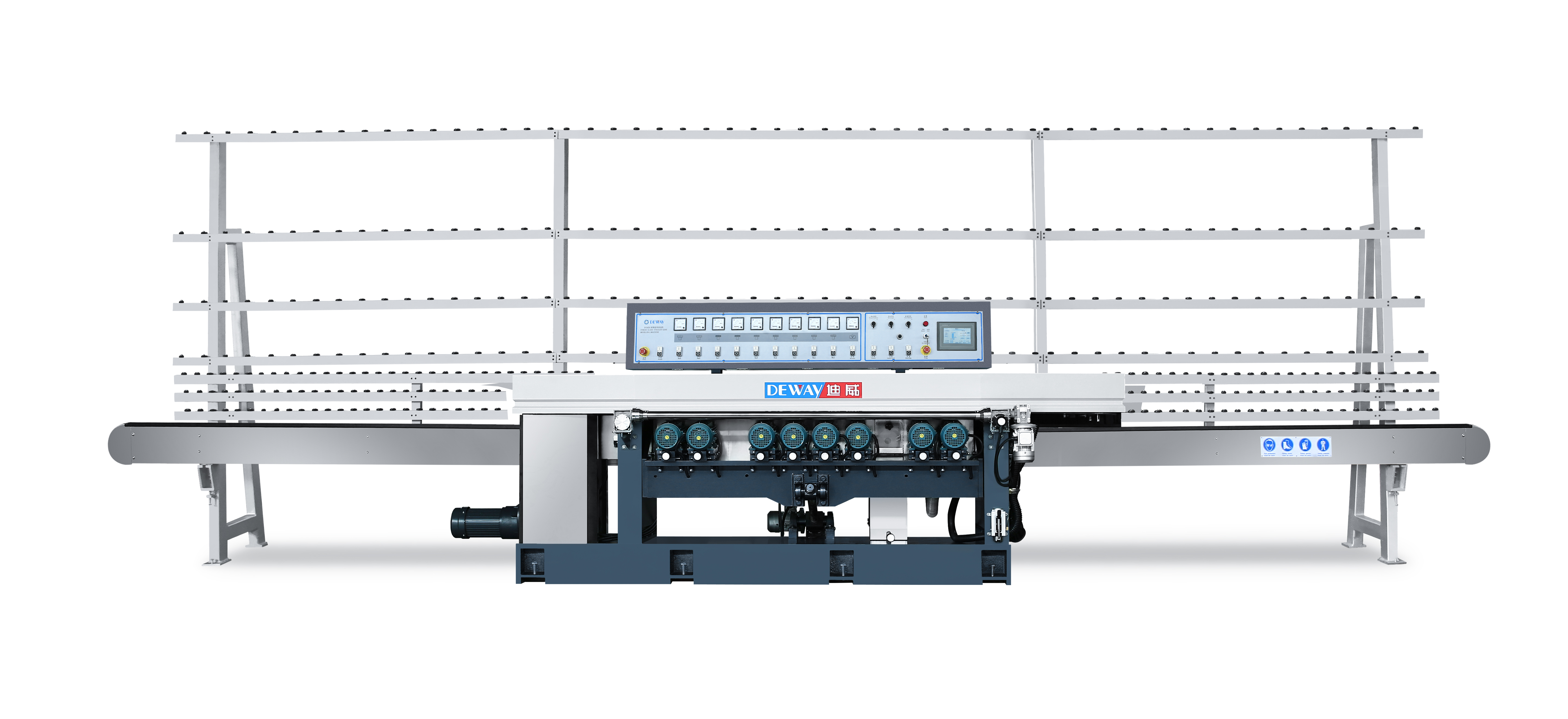
3. Automated Glass Beveling Machine
This machine is for straight bevels and rounded bottom edges on flat glass. It uses high-efficiency, low-energy motors. Main drives have infinitely variable speed reducers and synchronous belt conveyors. The rear chain plate is forged and heat-treated thick steel. Front/rear guide rails use ultra-wear-resistant materials. Some lifting-beam beveling machines can process glass as small as 30×30 mm, achieving bevel widths up to 35 mm and angles from 3° to 45°.
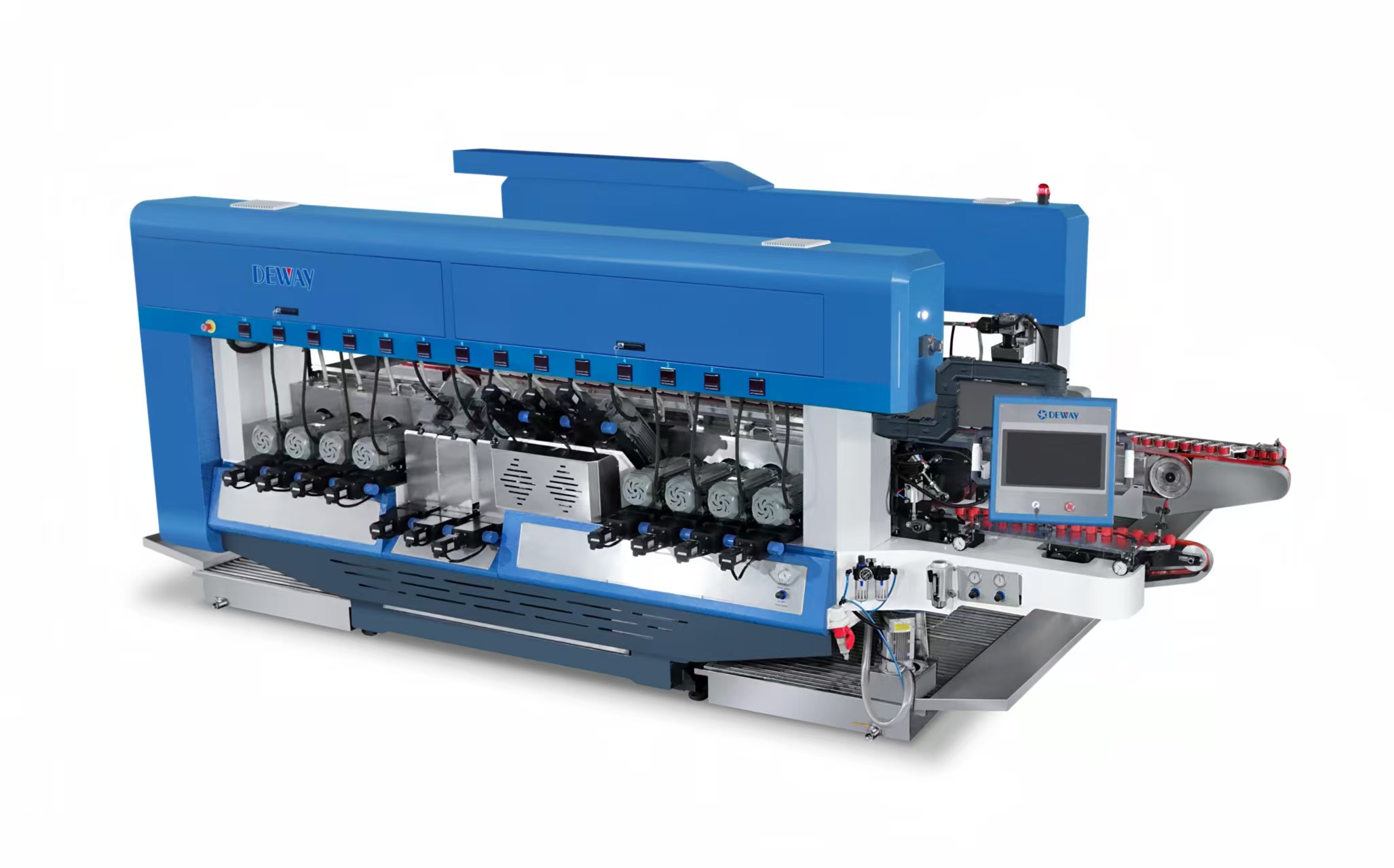
4. Automatic Glass Double Edging Machine
This advanced machine grinds and polishes both straight edges of flat glass at the same time. Grinding heads slide on double linear rolling guide rails with double ball-screw drives, eliminating play and ensuring repeatable positioning. A PLC system sets all parameters via an HMI. The conveyor belt drive uses a variable-frequency motor for constant power and torque. Polishing includes a pneumatic automatic compensation system. Double edgers are popular in large tempered glass factories. Models range from 16 to 28 grinding heads.
5. Glass Straight-line Pencil Edging Machine
This machine grinds straight rounded edges (pencil edges) and ogee edges on flat glass of various thicknesses. Rough, fine, and polishing are done in one pass. Glass thickness is adjusted by moving the front guide rail. An infinitely variable speed reducer gives stable, highly precise speed control. Typical machines have 6 or 8 grinding heads.
Beyond these five, the industry also uses single-arm irregular edgers, profile edgers, and fully automatic shape edging/beveling machines (which handle any shape from 1–12 mm glass, minimum size 100×80 mm, completing edging, chamfering, and polishing safely with high automation).
Key Applications and Features
Glass edging machines are mainly used for furniture glass, architectural glass, and craft glass. They are among the most heavily consumed cold-processing machines in the glass industry. Their three distinctive features:
● Single-purpose (but with profile options)
● Continuous grinding – high efficiency
● Ability to handle large flat glass panels
Control options include manual, digital display, and PLC computer control.
Installation Requirements
Install on a level floor. After installation, the machine must be perfectly horizontal in all directions; otherwise edge quality suffers. Ensure correct electrical connection – some countries use 415V/50Hz, 220V/50Hz, or 220V/60Hz. Wrong wiring can burn motors or electrical components. Because the machine runs with water and electricity, verify that the floor-mounted water tank supplies enough water for your production volume.
Maintenance and Daily Care
Inspection
If water, electricity, or oil leaks, stop immediately and fix the problem.
Watch instrument readings and listen for unusual noises.
Maintenance schedule
● Daily – clean the machine and remove debris.
● Every 15 days – replace circulating water to prevent glass powder from clogging the pump and hoses.
● Monthly – apply lubricating grease to chains, gears, and ball screws.
Safe Operating Guidelines
Follow these rules to maximize machine life and safety.
1. Read the manual first – Understand the transmission, handles, buttons, water/air adjustments, and maintenance procedures before operation.
2. Respect grinding heads – Their position and clearance are factory-set. Avoid unnecessary adjustments. Do not retract the head too far; that can damage the water seal and cause motor burn-out.
3. Keep cooling adequate – Frequently check for blocked cooling lines, especially on straight-line edgers where bristles can cause invisible clogs.
4. Adjust variable speed drives only when running – Changing speed with the machine off can damage the transmission.
5. Irregular (shape) edging machines – Keep all suction cup holders at the same height. Do not disassemble them unless necessary. Check vacuum pump performance regularly – loss of suction reduces quality and creates safety risks.
6. Straight-line edgers (straight edge, pencil edge, beveling) – These machines use front and rear pressure plates to grip and move the glass. Always lubricate the mating surfaces between pressure plates and guide rails. Set clamping force properly: too loose reduces quality, too tight increases load and may crush thin glass. A good test: clamp a medium-size glass, then try to move it by hand with the machine off – you should not be able to move it easily.
7. Profile (templet) edging machines – The template greatly affects accuracy. Ensure the template has precise dimensions, a high finish, and smooth transitions for irregular shapes. Keep the suction cup working surface level after changing templates or cups.
8. Double-edging machines – These are high-end machines. Operate them with two or three trained, consistent personnel. If program errors occur, call the original manufacturer for repair. Avoid unauthorized disassembly.
Conclusion
Whether you need straight edges, miters, bevels, double edges, or pencil edges – choosing the right equipment (from a Glass Straight-line Edging Machine to a Glass Miter Machine, an Automated Glass Beveling Machine, an Automatic Glass Double Edging Machine, or a Glass Straight-line Pencil Edging Machine) and following correct installation, operation, and maintenance will deliver high output, excellent edge quality, and long machine life.
As glass applications evolve, these machines remain indispensable. Proper knowledge and care are the keys to safe, efficient glass processing.