
Summary: In 2024, China's flat glass market witnessed synchronized declines in both futures and spot prices, though with differing rhythms. While production capacity may have bottomed out, demand from the real estate sector continued to slump. Looking ahead to 2025, exports of raw glass and deep-processed products—along with the performance of key glass processing machinery such as CNC Glass Processing Machines, Automatic Glass Double Edging Machines, Glass Bearing Edging Machines, Glass Variable Mitering Machines, and Vertical Washing Equipment for Glass—could become decisive factors in determining inventory levels and overall supply-demand balance.

1. 2024 Price Review: Futures and Spot Diverge, Then Converge
The year 2024 was marked by persistent downward pressure on glass prices, yet the timing of futures and spot price movements differed significantly.
Futures market: Prices fell first and then rose during the first half of the year. After June, they entered a prolonged three-month decline, hitting nearly 1,000 yuan/ton in mid-September before staging a staged rebound.
Spot market: A long-term downtrend dominated, with prices bottoming out and recovering only in late September. By late December, the annual decline for 5mm flat glass in Shahe and Hubei reached approximately 27.14% and 36.55%, respectively.
The divergent rhythms reflected changing market expectations, profit margins, and production adjustments throughout the year.
2. Capacity Outlook: Production Likely Bottomed in 2024, Modest Changes in 2025
From January to November 2024, the average daily molten output of float glass stood at 169,600 tonnes, a modest year-on-year increase of 1.41%. Total float glass production for the same period reached 50.2454 million tonnes, up 3.90% from a year earlier.
However, after March, as industry profits shrank, production lines began to halt or undergo cold repairs. By late September, operational capacity had fallen to its lowest five-year level. Because first-half output remained historically high, the full-year average was elevated, and despite a sharp production drop in the second half, total 2024 output is estimated at 54.6689 million tonnes—a 3.07% increase over 2023.
Since late September 2024, industry profits have partially recovered, which is likely to slow the pace of cold repairs. Even though 2025 will still see a mix of cold repairs and restarts, glass supply may have already bottomed out.
Based on current data, the average daily melt in 2025 is expected to drop by about 6% year-on-year to roughly 159,400 tonnes. Because the 2024 average was pulled up by high first-half levels, the 2025 annual average would still be slightly higher than the level at the end of 2024. Consequently, glass output in 2025 is projected to inch up by 0.19% to approximately 54.7728 million tonnes.
> *Key takeaway: Capacity changes in 2025 will be limited—a slight increase from the low base of late 2024, but a decline from the 2024 average.*

3. Demand Dynamics: Real Estate Continues to Drag, but Home Renovation and Subsidies Offer Partial Offsets
3.1 Weak Real Estate Fundamentals
Glass demand remained depressed in 2024. From January to November, China's commercial housing sales area fell 14.3% year-on-year, while new construction starts, floor space under construction, and completed floor space dropped by 23%, 12.7%, and 26.2%, respectively.
Weak downstream activity dragged down glass consumption. From January to October 2024, domestic float glass consumption reached 44.261 million tonnes, down 0.85% year-on-year. Although year-end rush‑to‑build demand supported November–December activity, some downstream producers were expected to start holidays early. Full-year 2024 glass consumption is estimated at 53.054 million tonnes, a decline of roughly 2.61% from 2023.
3.2 Medium‑Term Outlook: Completion Area Still Negative
Housing starts entered negative growth in 2020, with the decline widening from the second half of 2022. Although the contraction narrowed in 2023–2024, cumulative starts are still more than 20% below previous levels. Using a typical lead time of 18–24 months from start to completion, the completed floor area will remain in negative territory through 2025–2026, implying further declines in glass consumption.
3.3 Policy Support and Bright Spots
On December 9, 2024, the Political Bureau of the CPC Central Committee announced more proactive macro policies for 2025, including "expanding domestic demand," "implementing more proactive fiscal policy and moderately accommodative monetary policy," and "stabilizing the property and stock markets." While these measures could help the property sector stabilise, it will take considerable time for them to filter through to the glass supply chain.
Encouragingly, second‑hand home renovation demand and government subsidy programs (e.g., "trade‑in"schemes) are expected to drive a moderate amount of home‑furnishing replacement, boosting consumption of automobiles, electronics, and home appliances. This could partially offset the decline in demand from new construction.
Scenario projections for 2025 glass consumption:
- Optimistic case: 3% decline → 51.46 million tonnes
- Pessimistic case: 6% decline → 49.87 million tonnes
4. Inventory and the Critical Role of Exports
4.1 Current Inventory Levels
In 2024, glass industry inventories fluctuated at medium‑to‑high levels. In late September, downstream and midstream buyers increased their drawdowns, significantly reducing producer stockpiles. By mid‑December, glass inventories stood at 47.625 million weight boxes, up 48.54% from the end of 2023.
4.2 The Missing Piece: Exports of Raw Glass and Processed Products
A simple demand‑versus‑supply analysis might suggest that the projected demand drop in 2025 will lead again to high inventories. However, such an analysis often overlooks net exports of raw glass and deep‑processed glass products (converted into raw glass equivalents).
In the past two years, net exports of raw flat glass have remained modest at about 460,000–470,000 tonnes. But when deep‑processed products (e.g., tempered, laminated, insulated glass) are also converted, the net export volume substantially relieves domestic supply pressure.
For 2024, total net exports of glass and deep‑processed products (converted to raw glass) are estimated at 3.273 million tonnes, down 3.26% year‑on‑year.
4.3 Uncertain Export Outlook for 2025
Several factors will shape glass exports in 2025:
- A strong US dollar makes Chinese glass products more competitive globally.
- Trade frictions could create headwinds and volatility.
Two scenarios for 2025 net exports (glass + processed products converted to raw glass):
- Pessimistic case: 3.074 million tonnes (down 6% from 2024)
- Optimistic case: 3.260 million tonnes (a slight retreat from this year)
5. The Role of Glass Processing Machinery in Trade and Supply Balance
Deep‑processed glass products are manufactured using specialised equipment. The export performance of these products—and thus their ability to absorb domestic supply—depends heavily on the competitiveness and technological advancement of China's glass processing industry. Key machinery that underpins this sector includes:
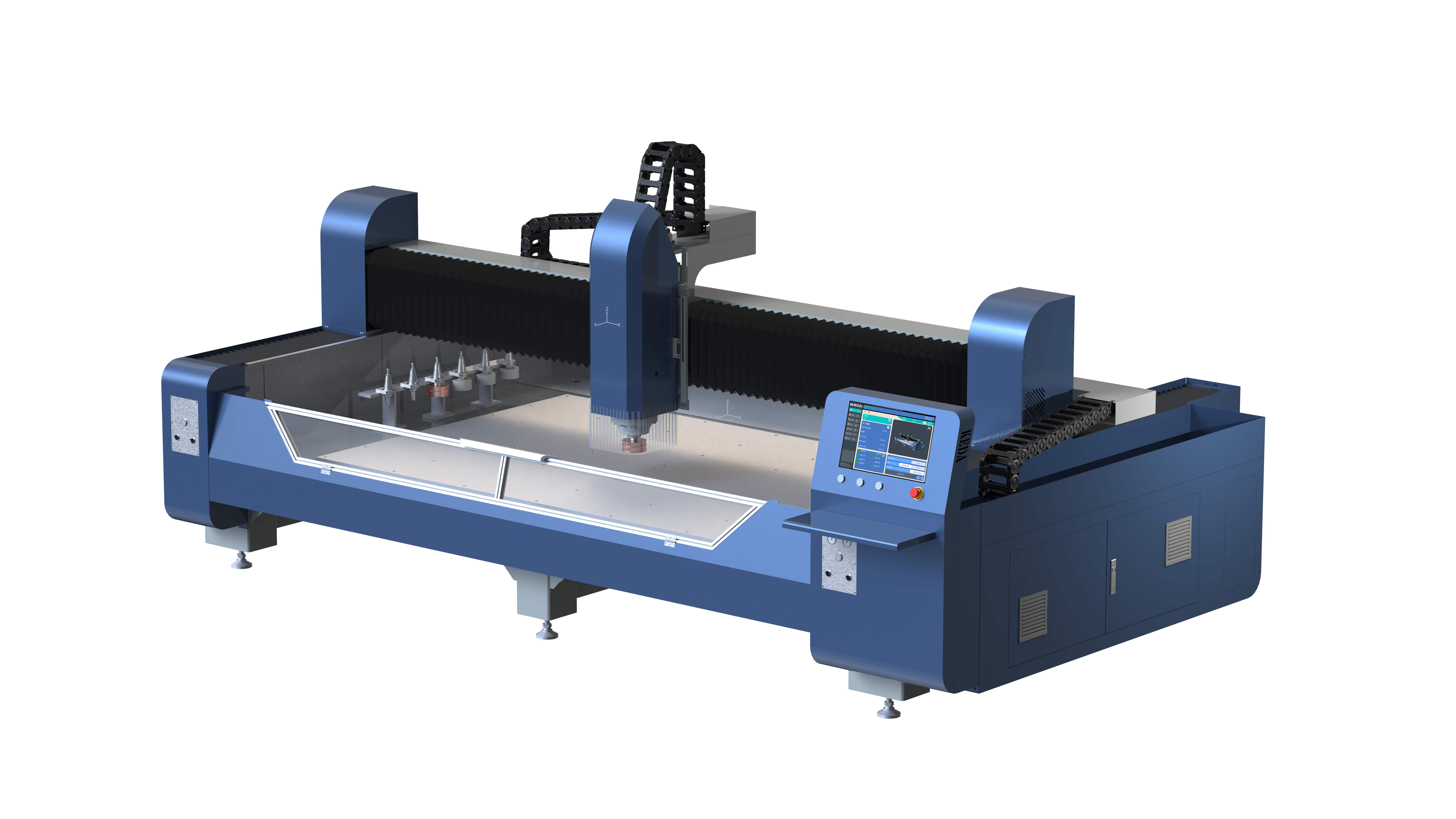
- CNC Glass Processing Machine—enabling high precision cutting, drilling, and milling for complex shapes.
- Automatic Glass Double Edging Machine—essential for producing smooth, parallel edges on large volumes of flat glass with consistent quality.
- Glass Bearing Edging Machine—used for fine edging and polishing, particularly where bearing surfaces or tight tolerances are required.
- Glass Variable Mitering Machine—allowing accurate miter cuts at variable angles for architectural and furniture glass.
- Vertical Washing Equipment for Glass—critical for cleaning glass before coating, lamination, or insulating glass assembly, ensuring defect‑free surfaces.
The availability, efficiency, and export competitiveness of these machines directly affect the quality and cost of Chinese deep‑processed glass products. In 2025, if global demand for such processed glass remains resilient—especially in automotive, electronics, and high‑end construction—China's exports of finished products (made with advanced equipment like the above) could help offset domestic demand weakness. Conversely, if trade barriers or global slowdowns hurt machinery‑enabled processing capacity utilisation, the net export buffer would shrink, intensifying inventory pressure.
6. Conclusion: Exports as the Decisive Factor in 2025
Whether the glass market achieves a fundamental balance in 2025 largely hinges on net exports of glass and deep‑processed products.
- If net exports can offset the projected decline in domestic demand (i.e., 3–6% drop in consumption), the annual supply‑demand gap could be minimal, and inventories may remain manageable.
- If exports are significantly constrained—e.g., by intensified trade frictions—the supply‑demand surplus could reach around 1.83 million tonnes, translating into higher inventories and continued price pressure.
The performance of China's glass processing industry, supported by advanced machinery such as CNC Glass Processing Machines, Automatic Glass Double Edging Machines, Glass Bearing Edging Machines, Glass Variable Mitering Machines, and Vertical Washing Equipment for Glass, will be crucial in maintaining export competitiveness and absorbing domestic overcapacity.
Thus, as 2025 unfolds, market participants should closely monitor not only real estate completion data and policy stimuli, but also export orders for both raw glass and value‑added processed products—and the sophisticated equipment that makes them possible. The answer to the question "Will the glass market find a balance?" depends to a surprising degree on global trade dynamics and the health of China's glass deep‑processing sector.