
Glass is one of the oldest man-made materials, yet it remains a paradox. Its theoretical strength approaches 7,000 MPa, but commercial glass products typically break at just 35-70 MPa – a gap of nearly two orders of magnitude. Why does glass fail to live up to its potential? The answer lies in its intrinsic brittleness and the omnipresent surface microcracks. And the solution? A combination of material science and a new generation of precision processing machinery that is redefining the strength limits of this ubiquitous material.
The Brittleness Dilemma: Microcracks Are the Real Culprit
The huge discrepancy between theoretical and practical strength stems from glass’s inability to plastically deform. According to Griffith’s microcrack theory, every glass surface harbours countless microscopic flaws. When stress is applied, these cracks propagate catastrophically because glass cannot yield; the stress concentrates at the crack tips, leading to sudden fracture. Even worse, chemically unstable glass surfaces can develop microcracks from environmental corrosion, cutting mechanical strength by as much as 95% – down to one-twentieth of the original value.
Five Pillars to Boost Mechanical Strength
Material scientists have tackled this challenge from multiple angles. The five main strategies to increase glass strength are:
1. Increasing Hardness – The First Line of Defence
Scratches are a major source of microcracks. Enhancing hardness, especially abrasion resistance, is crucial. Hardness is governed by composition; oxides contribute in the order: SiO₂ > B₂O₃ > MgO > Al₂O₃ > K₂O > Na₂O > PbO. For high-temperature glasses, Mohs hardness varies: 7.2 for 500°C-resistant glass, 6.2 for 1200°C grades, and recent optimisations have pushed ultra-high-temperature glasses to 7.5-9.5.
2. Improving Chemical Stability – Preventing Invisible Erosion
Poor chemical stability invites surface attack, creating microcracks that drastically lower strength. For sight glasses and other chemically exposed products, Class 1 water resistance (ISO 720-85) is mandatory. Borosilicate glasses excel here, and adding MgO further enhances both durability and mechanical strength.
3. Homogenising Glass Composition – Eliminating Built-in Defects
Inhomogeneity causes severe strength reduction. Macroscopic defects like stones, striae, and cords are partly unavoidable, with stones being the most detrimental. Even more troublesome are microscopic inhomogeneities – visible only under 5000× electron microscopes – which arise from melting fluctuations or improper heat treatment, leading to phase separation and embrittlement. Higher melting temperatures and refined processes are essential to counter these issues.
4. Reducing Internal Stress – Releasing the Hidden Tension
Stress from compositional gradients or temperature differences greatly weakens glass. Thermal stress is linked to the coefficient of expansion; thus, selecting low-expansion glasses and applying proper annealing are critical. Annealing reheats the glass to allow stress relaxation, controlling residual stress within safe limits to preserve strength and durability.
5. Optimising Shape Design – Simplicity Works Best
Geometry matters. Simple shapes and uniform thickness significantly raise strength. In recent years, safety requirements have driven a trend toward thicker high-temperature glass. Moreover, curved structures outperform flat panels – studies show that arched glass of the same thickness and area offers higher bending and load-bearing capacity.

The Machining Revolution: Precision Equipment Guards Every Edge
While material improvements lay the foundation, modern processing machines are the unsung heroes that translate theoretical strength into practical reliability. Today’s advanced equipment ensures that edges are flawlessly finished, eliminating the stress-raising defects that cause premature failure.
- Double Glass Processing Machine – This workhorse completes grinding and polishing of two parallel straight edges and chamfers in a single pass. With high precision, speed, and stability, it is widely used in architectural and automotive glass production, delivering bright, uniform edges with minimal deviation.
- Glass Polishing Machine – Dedicated to bottom edges and bevels, this machine features rigid sliding guides, low vibration, and multiple grinding heads (from 4 to 10 units) to suit different accuracy needs. Its adjustable speed and easy setup make it a versatile tool for straight-edge finishing.
- Glass Miter Machine with 45 Degree – An evolution of the straight-edge polisher, this machine adds multi-step edge capability. The front bevel head can switch between 45° and 90° electrically, allowing one-pass processing of stepped edges, bottom edges, and back bevels. With angle adjustment from 0° to 45°, it integrates coarse grinding, fine grinding, polishing, and chamfering in a single run.
- Glass Straight-line Bevelling Machine – Designed for linear bevels and rounded bottom edges, it comes with 9, 10, or 11 grinding heads. Direct-drive motors reduce noise and maintenance, while dual-motor screw control ensures precise angle setting. After rough, fine, and polishing stages, the bevel surface achieves a mirror-like finish with exact angle accuracy.
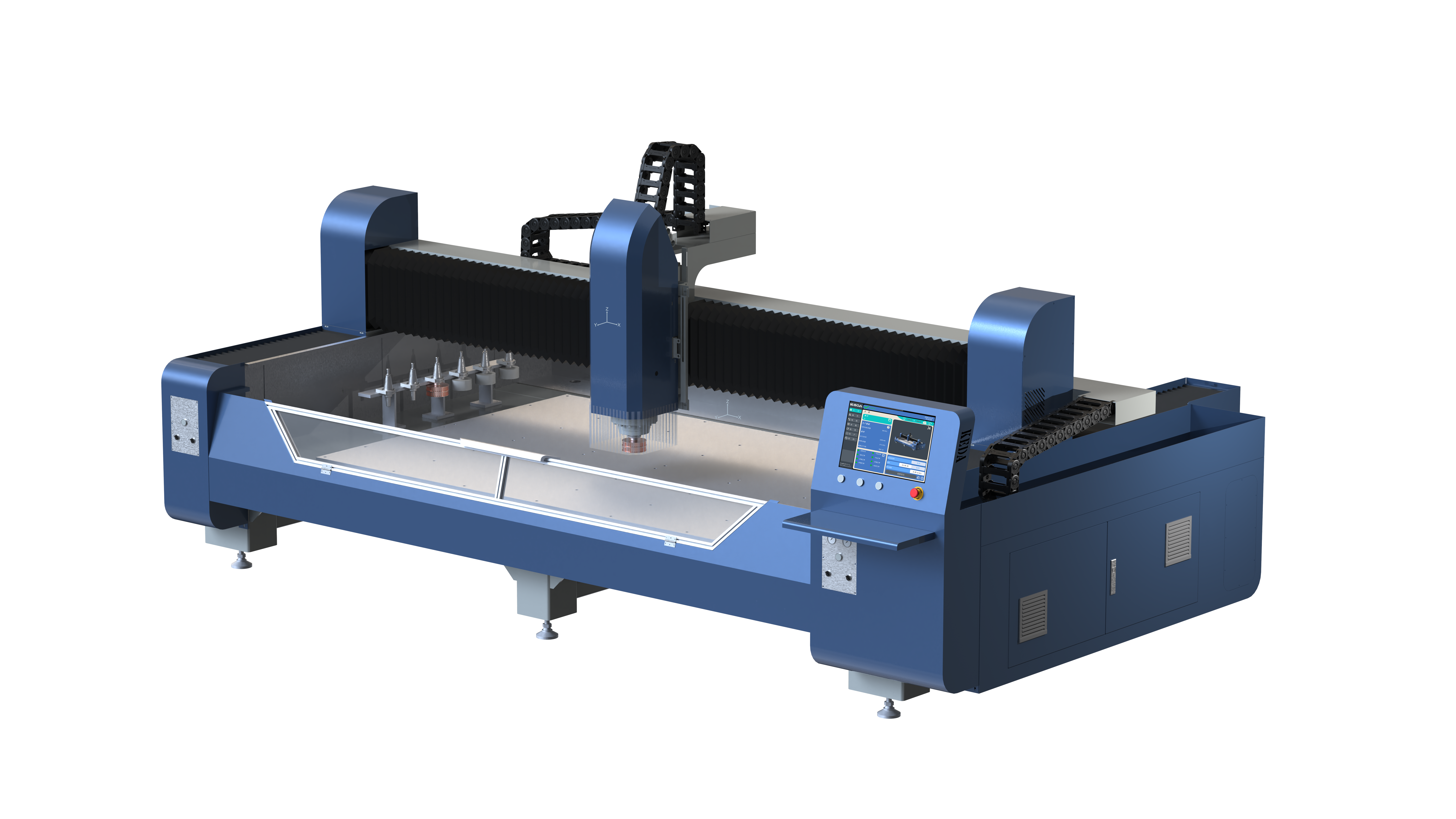
- CNC Working Center – The ultimate integrator, this computer-controlled centre combines straight-edge grinding, beveling, and shaped-edge machining, as well as cutting, engraving, and drilling – all via programming. Handling glass thicknesses from 2 to 25 mm, with adjustable feed rates of 0-15 m/min and flexible single- or double-station operation, it drastically improves efficiency and precision, becoming the core equipment for high-end glass products.
Beyond Machining: Strengthening from the Inside – Tempering and Microcrystallisation
Machining removes surface flaws, but additional post-processing can elevate strength to new heights.
Thermal tempering (physical toughening) rapidly quenches glass to create a compressive surface layer, greatly increasing impact resistance. Chemical tempering (ion exchange) replaces sodium ions with larger potassium ions, inducing a “crowding” effect that builds compressive stress. Chemically toughened glass achieves 3-5 times the bending strength and 5-10 times the impact resistance of untreated glass.
Recent 2024 innovations include a triple-strengthening process that gradually boosts surface compressive stress to 900-1100 MPa by adjusting nitrate bath compositions in stages. Systematic evaluation of Li₂O-Al₂O₃-SiO₂ (LAS) glass shows that thermal tempering raises flexural strength by only 23% (to 338 MPa), while ion-exchange and hybrid strengthening boost it by 382% and 393%, respectively. Hybrid-strengthened glass excels in impact resistance (surviving 3.5-metre drops) and hydrostatic pressure tolerance (7.20 MPa).
Microcrystallisation offers another breakthrough: transforming glass into glass-ceramics allows crystals to deflect and bridge cracks, vastly improving fracture toughness. Magnesium-aluminium-silicate (MAS) glass-ceramics, after combined crystallisation and ion-exchange, achieve an 18.6-fold increase in crack resistance and a hardness of 7.93 GPa.
Conclusion: A New Era for Glass – Stronger, Safer, More Versatile
From fragile to formidable, the journey of glass strength reflects the synergy between material science and precision engineering. With advanced machines – the Double Glass Processing Machine, Glass Polishing Machine, Glass Miter Machine with 45 Degree, Glass Straight-line Bevelling Machine, and CNC Working Center – alongside annealing, tempering, surface treatments, microcrystallisation, and composites, glass is shedding its brittle image. Its future shines bright in architectural facades, smart transportation, electronic displays, aerospace, and beyond – proving that even the oldest materials can be reborn through innovation.