
As record-breaking heatwaves sweep across the globe in summer 2026, a hidden danger is shattering glass curtain walls from Shanghai to Kunming. In March alone, multiple high-rise buildings reported spontaneous glass breakage, with repair costs exceeding 10,000 yuan per panel. The culprit is not impact or poor workmanship, but a physical phenomenon called thermal stress—and understanding it could save lives and millions in maintenance.
1. The Science: Why Sunlight Breaks Glass
When glass is installed on a building and exposed to direct sunlight, it absorbs infrared and visible light, converting that energy into heat. The glass temperature rises, and it expands. However, when the pane is framed in an aluminum system, the portions hidden inside the frame stay cooler than the exposed central area. This uneven heating creates a temperature gradient: the hot center expands while the restrained edges do not, generating tensile stress at the edges. If that stress exceeds the glass's tensile strength, it fractures.
Studies show that west- or east-facing glass can reach 70°C on a summer day. A temperature difference of just 43°C between the center and the edges can trigger breakage. Even tempered glass has a limit of about 100°C; glass with scratches or bubbles loses over 70% of its strength. Improper installation gaps or mismatched frames further worsen the risk.

2. First Defense: Precision Edge Processing
The most effective way to reduce thermal stress risk begins at the fabrication plant. High-quality edge finishing eliminates micro-cracks where stress concentrates. Five key machines form this frontline:
2.1 Glass Polishing Machine
This cold-processing tool grinds and polishes flat glass edges and chamfers in one pass. By removing sharp edges and microscopic defects, it significantly reduces stress concentration points—precisely where thermal tensile stress is highest.
2.2 Glass Double Edging Processing Machine
For large-scale production, this machine processes two parallel straight edges simultaneously, performing rough grinding, fine grinding, and polishing. With multiple spindles, it delivers consistent, high-precision edges that minimize stress risers across the entire pane.
2.3 CNC Glass Processing Center
This automated system integrates cutting, drilling, milling, and grinding in one unit. It handles complex shapes and high-precision requirements for modern curtain walls, ensuring every edge meets exact specifications and eliminating human errors that could create weaknesses.
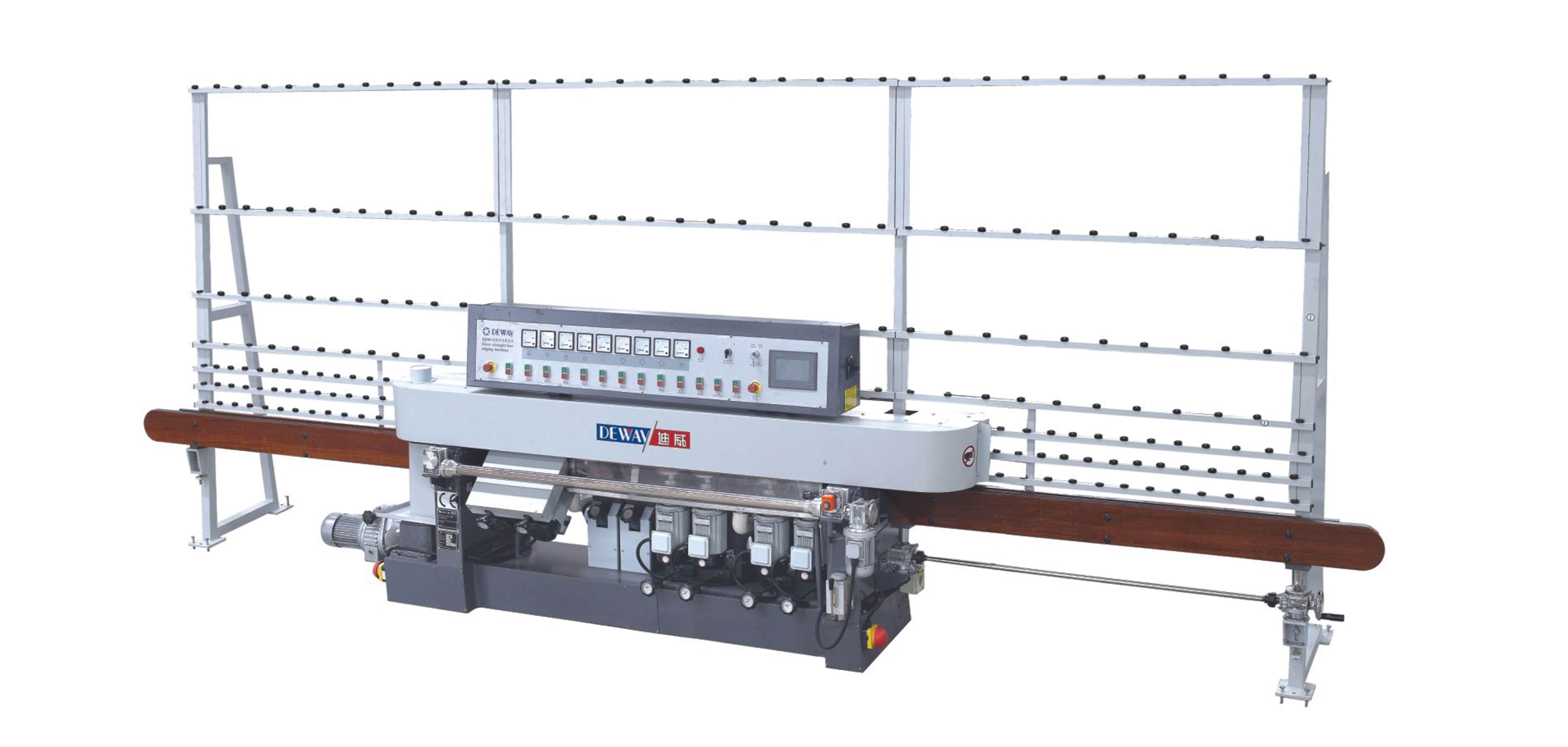
2.4 Glass Straight-line Bevel Machine
Specializing in beveled edges, this machine combines coarse grinding, fine grinding, and polishing of both the bevel and the bottom edge. Smooth, gradual transitions reduce localized stress, while also improving aesthetics for visible applications.
2.5 Automatic Glass Washing Machine
Before tempering or insulating assembly, this machine cleans and dries glass surfaces, removing dust, oil, and powder. A contaminant-free surface ensures uniform tempering and reliable sealant adhesion—both critical for thermal durability.
Together, these precision processes create defect-free edges that can withstand the pull of thermal expansion.
3. How to Recognize Thermal Stress Breakage
Experts identify three telltale signs:
Step 1—Clean, Few Cracks
Thermal stress breaks have neat, clean origins with few fracture lines. The pattern is a single or multiple zigzag lines radiating outward, unlike impact breaks with concentric rings.
Step 2—Right-Angle to Edge
The fracture line typically runs at a 90-degree angle from the glass edge. If it is oblique or irregular, suspect bending stress or pre-existing edge flaws.
Step 3—Arced Central Lines
In the middle of the pane, cracks often form arc shapes. They usually start at the edge or corner and, about 50 mm inward, split into two or more branches heading toward the center.
4. Prevention: A Multi-Layer Approach
Avoiding thermal stress requires action at every stage:
- Design: Perform thermal stress analysis early. Tinted and coated glasses absorb more heat, so choose wisely. Allow 4–7 mm expansion gaps in frames and use elastic sealants.
- Fabrication: Use the five precision machines above to ensure optimal edge quality and surface cleanliness before tempering.
- Installation: Follow gap specifications strictly. Heat-treated glass (tempered or heat-strengthened) offers far higher resistance—tempered glass can handle temperature differentials up to 250°C.
- Distinction: Remember that nickel sulfide (NiS) inclusions cause a different type of spontaneous breakage, originating from internal impurities. Thermal stress breakage is purely temperature-driven and preventable through proper processing and design.
5. Conclusion: A Shared Responsibility
From the polishing machine's fine grinding to the double edger's efficient processing, from the CNC center's precision to the bevel machine's smooth finishing and the washer's cleanliness—every step builds resilience against thermal stress. As cities rise with glass facades, ignoring this silent threat is not an option. Only through rigorous fabrication, thoughtful design, and careful installation can we safeguard our skylines against the relentless summer sun.
The question is not whether thermal stress will strike—but whether we are ready to stop it.