
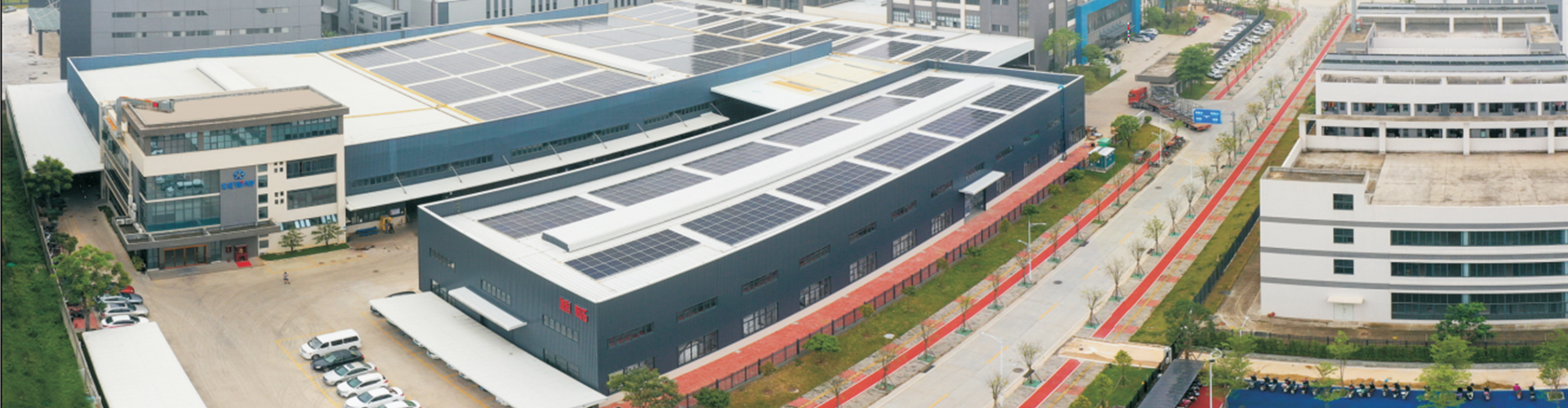
1. Market Drivers and Equipment Diversity
Glass products are rapidly evolving toward functional, practical, and decorative uses across construction, automotive, photovoltaics, and smart home sectors. This shift drives strong demand for deep-processing machinery, with the global market expected to grow at over 6% CAGR in the next five years. Among the various machine types, Glass Straight Line Edging Machine remains the core workhorse, covering coarse grinding, fine grinding, and polishing in one unit. However, modern production lines also rely on Double Glass Processing Machine for high-volume parallel-edge grinding, Automated Glass Beveling Machine for decorative angled edges, and CNC Glass Grooving Machine for intricate surface patterns. All these machines depend on a precise Automatic Glass Transfer Table to ensure stable workpiece movement and consistent quality.
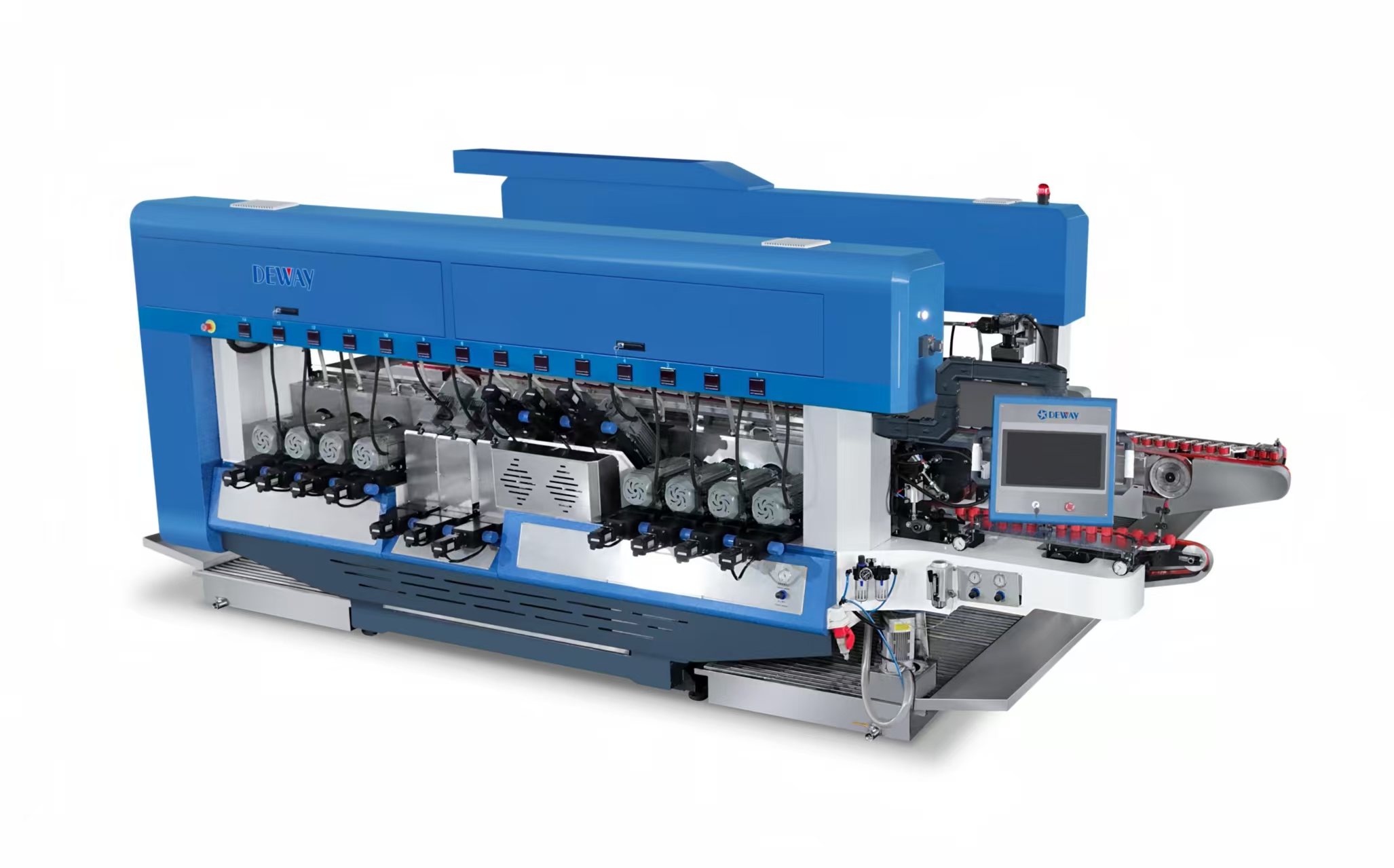
2. Technical Core of the Glass Straight Line Edging Machine
The primary function of this machine is to grind glass edges into specific shapes—straight, rounded, beveled, or custom profiles. Its mechanical structure consists of two main parts: the grinding feed system and the processing worktable. The worktable, which essentially acts as an Automatic Glass Transfer Table, carries the glass sheet driven by a standard AC motor, while the grinding wheels are rotated by separate AC motors. Early models used mechanical continuously variable transmissions, but today's machines adopt variable-frequency drive (VFD) motors for smooth speed regulation, better energy efficiency, and reduced maintenance. More importantly, the grinding feed system now employs AC servo motors with closed-loop control, precisely adjusting the wheel trajectory to handle complex contours—giving the edging machine a flexibility comparable to that of a CNC Glass Grooving Machine, yet with much higher productivity.
3. Fully Automated Processing Workflow
Modern glass edging equipment integrates four essential steps—coarse grinding, fine grinding, end grinding, and polishing—into one continuous automated line. The process runs as follows:
- Automatic feeding: A loading mechanism delivers raw glass sheets to the clamping entry.
- Elastic clamping and conveying: Specially designed elastic grippers hold the glass firmly but gently, absorbing vibration, and move it forward at a controlled speed.
- Sequential machining: The glass passes through coarse grinding (removing burrs), fine grinding (smoothing surface), end grinding (squaring edges), and polishing (achieving glossy finish)—all in a single pass.
- Automatic unloading: A take-off unit receives the finished piece and transfers it to the next stage.
This integrated design eliminates multiple machine transfers and manual handling, reducing positioning errors and ensuring consistent quality for large-batch production.
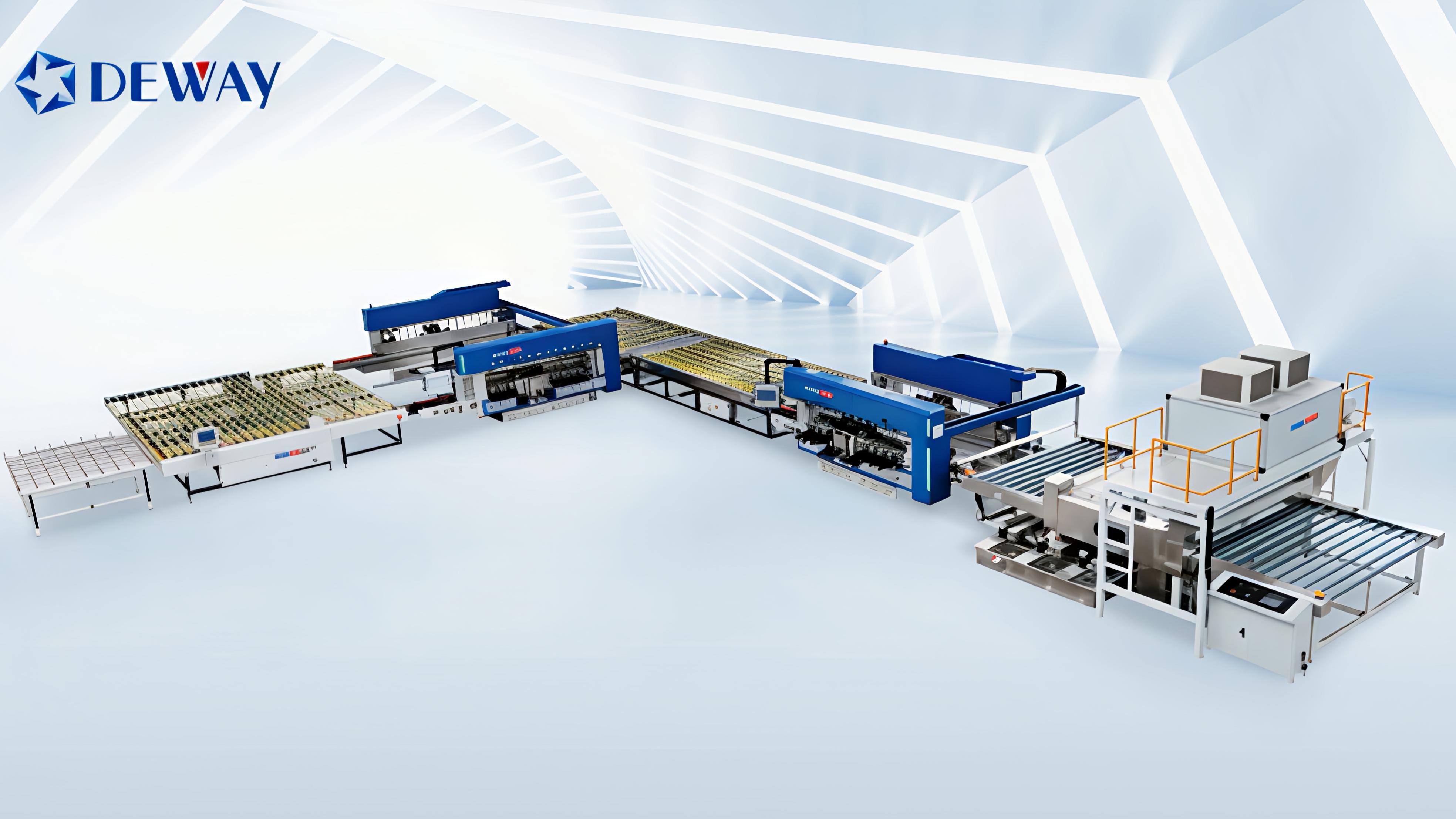
4. Complementary Equipment and System Synergy
While the Glass Straight Line Edging Machine handles general straight edges, many factories add specialized units to meet diverse requirements. The Double Glass Processing Machine processes both parallel edges simultaneously, doubling throughput for flat glass like windows and solar panels. The Automated Glass Beveling Machine creates decorative angled edges for mirrors, tabletops, and display cases, requiring precise angular control often achieved with servo-driven wheels. For high-end decorative work, the CNC Glass Grooving Machine carves grooves, channels, and complex 3D patterns on the glass surface, adding artistic value.
All these machines rely on a common Automatic Glass Transfer Table as the backbone, ensuring smooth, synchronized movement between stations. The transfer table must maintain constant speed and positional accuracy, as any fluctuation directly affects edge quality and final dimensions.
5. Future Outlook
The industry is moving toward higher speed, greater precision, intelligent automation, and energy savings. VFD and servo technologies will continue to evolve, with online monitoring and adaptive compensation becoming standard features. Already, some high-end systems integrate in-process gauging that adjusts feed rates based on real-time wheel wear, extending tool life and stabilizing output.
As factories adopt Industry 4.0 principles, these machines—edging, beveling, grooving, and double-edge units—will be interconnected via the transfer table, enabling dynamic scheduling and remote diagnostics. The synergy between them will define the competitiveness of glass processors worldwide. The question is no longer whether full automation is possible, but how quickly manufacturers will embrace this intelligent, integrated future.